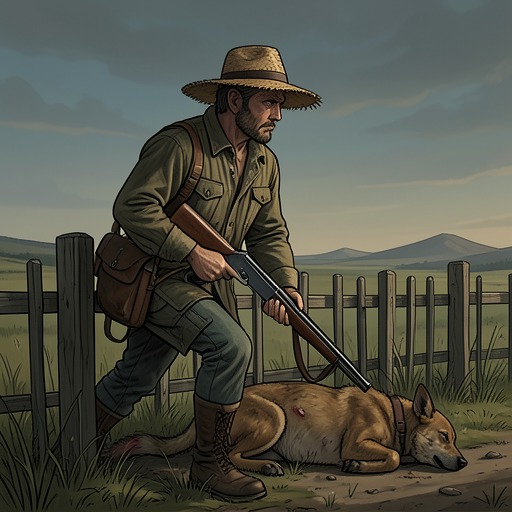
Boryna family farmstead
The PeasantsBoryna family farmstead is a substantial working household in Lipce, organized around seasonal labor and the storage and preparation of food, fuel, and livestock. Its barn, byre, and great chamber are not merely a domestic backdrop: they bring together the household’s work, its shared meals, and village gatherings, while the farm’s fortunes expose how closely security depends on land, labor, and the agricultural calendar.
Setting and working spaces
The farmstead’s spaces serve distinct but connected purposes. Wheat is threshed and stored in sacks on a cart in the barn; the byre holds animals and provides a place for winter preparations; and the large chamber accommodates both family meals and collective work. Before winter, brushwood gathered from the forest is divided between the byre and a stack against the house walls, where it helps insulate the building. These practical arrangements show a household preparing not for comfort alone but for the demands of the coming season.
The chamber is also a vivid communal interior. A fire in the chimney illuminates glazed pictures and colored wafer globes hanging from smoke-darkened beams. At one gathering, a heap of red cabbages fills the middle of the room while girls and older women sit in rows, stripping away the outer leaves and tossing the heads onto a sheet beneath the window. Jagna Borynowa joins the work after warming her hands at the stove; Kuba carries cabbages from the barn with Witek, while young men linger nearby, smoking and joking. The room’s objects and activity make household production visible even as the work becomes a social occasion.
Seasonal labor and provision
The farmstead’s routines intensify ahead of the fair on St Kordula’s Day, the last notable fair before Yuletide. Across Lipce, families calculate what they can sell and what they must buy, while taxes, commune contributions, debts, and earlier loans compete for scarce ready money. Even households with fifteen morgen are anxious about the sums; poorer families have still less room to maneuver. The fair is therefore both a seasonal marketplace and a test of household resources.
At Boryna family farmstead, Maciej Boryna and Kuba finish threshing the wheat. Józia Borynianka and Hanka Borynowa fatten the sow and select goslings for rearing. Antek Boryna and Witek fetch brushwood before expected rain, carrying some into the byre and stacking the rest against the house. Their work continues into the last night before the fair; only when the wheat is ready on the cart in the barn and preparations are complete does the family gather for supper in Boryna’s chamber.
Food marks the difference between the demands of labor and the immediate relief of a meal. In one long, plentiful dinner, the household eats meat, cabbage with peas, chicken soup with potatoes, and barley groats roasted with pork fat. The diners begin in silence, concentrating first on satisfying their hunger. When Józia is cooking, she eats hurriedly from the edge of the bench while watching the bowls and bringing out more food. The abundance of that meal contrasts with the cash shortage and winter anxiety that repeatedly constrain village households.
Household life and village gathering
The farmstead’s chamber accommodates work beyond the immediate needs of the family. As more women arrive to peel cabbages, the room grows noisier; Kuba and Witek bring in additional cabbages, while Józia Borynianka leads the work and laughter in Maciej Boryna’s absence. Hanka Borynowa moves about with her customary tight-lipped reserve. When Maciej enters, he greets those present in turn and, already flushed from drinking, talks unusually loudly. He wants to sit by Jagna Borynowa but hesitates under the company’s watchful attention because their agreement has not yet been settled. His public cheerfulness and hesitation make the gathering a setting where private intentions are exposed to village scrutiny.
Household authority and division of labor are apparent in these scenes. Cooking, animal care, food preparation, and winter provisioning fall to different members, while the chamber brings their work into view. A meal is served only after the day’s tasks are complete; a communal cabbage-peeling session turns domestic labor into a gathering of women, girls, and young men. The farmstead thus connects the family’s internal organization with Lipce’s broader social life without erasing the tensions among those who share its rooms and work.
Precarity and broader significance
The security suggested by a well-stocked dinner and completed harvest preparations is vulnerable to changes in family circumstances. After Antek Boryna’s household is driven from the paternal homestead, he and Hanka face a bitter winter on potatoes and salt, without two groszy to spare. Their cow may have to be sold, and Antek resists taking hired work even as Hanka fears they will not endure until spring. Their hardship makes expulsion more than a domestic quarrel: separation from the farmstead also means separation from its established resources and labor arrangements.
The farm’s significance extends beyond one household. When the men of Lipce are imprisoned after the forest conflict, the village’s fields lie fallow because too few workers remain. Women must manage livestock, gardens, fuel, and childcare as well as the urgent demands of ploughing and sowing. When neighboring villagers arrive to help, carts, ploughs, horses, and people move across the fields together; the first ploughs break the soil, and the workers sow seed with a gesture of religious reverence. Set against that collective dependence on land and labor, Boryna family farmstead stands as a concrete instance of the novel’s rural order: a home is also a productive unit, and its provision depends on the people, animals, stores, and seasonal work gathered within and around it.